Into the quiet: An overnight trip to Tam Coc

© Joe Newman / X-Peditions
By midweek, it’s time to take a break from the city.
You have found your footing in the Old Quarter, learned to wade through the scooter traffic and made a handful of photographs you are proud of. You have been shooting since before sunrise most mornings and something has started to shift — the way your eye composes the scene before ever lifting your camera, the patience with which you wait for a moment. Now, it’s time load into a minibus and leave the city behind us.
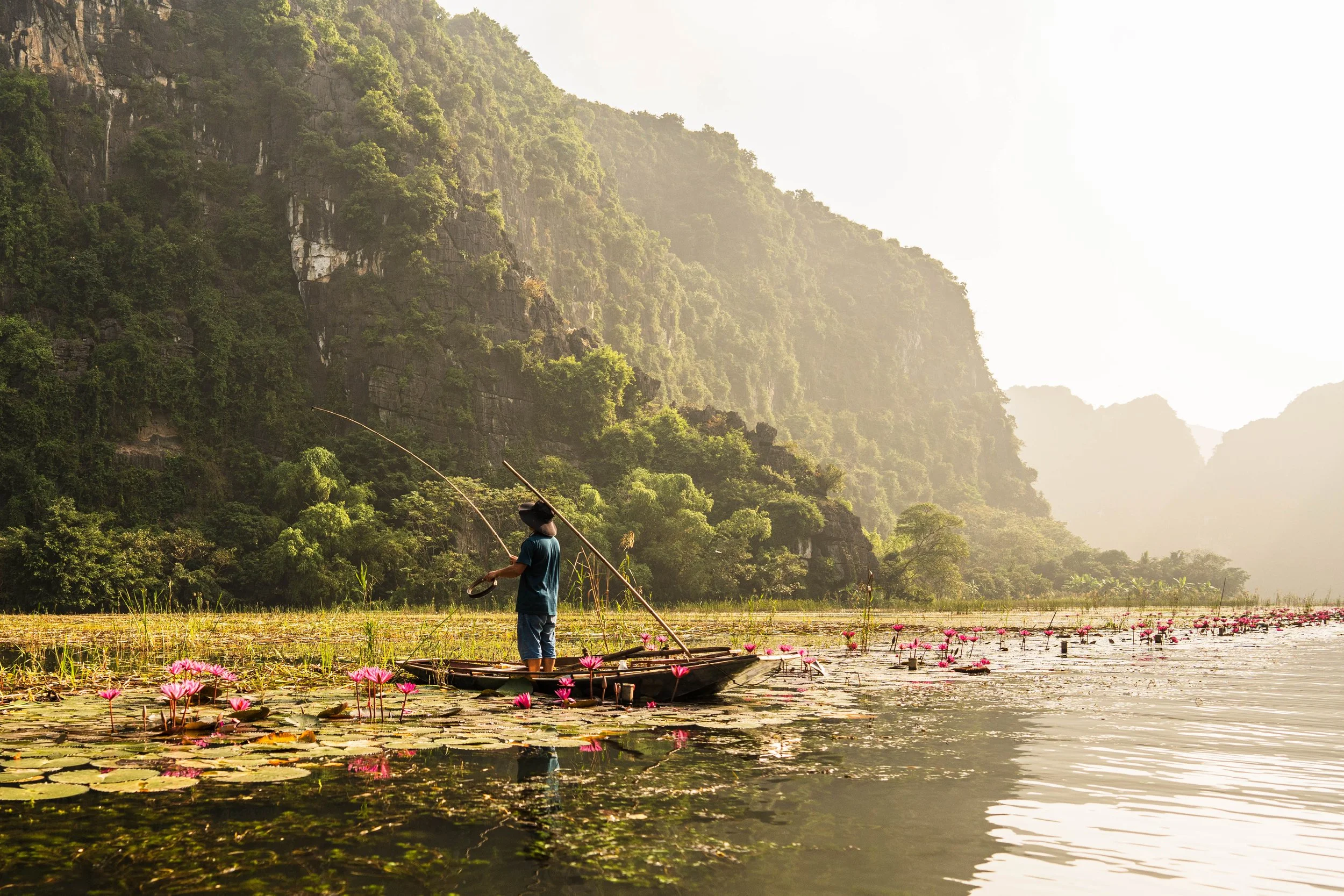
Three hours south, the world gets very quiet, very green, and very old. Welcome to Tam Coc.
© Joe Newman / X-Peditions
The Valley Arrives All at Once
There is a specific moment on the way when the flat rice country suddenly punctuates itself with limestone. The karst peaks of Ninh Bình Province appear vertical and enormous, rising from paddies still ankle-deep in water. For landscape photographers, the visual hit is immediate. For street photographers who have spent the past few days working in alleys and markets, it is a useful reminder that storytelling works the same way here: find what compels you, move toward it and wait.
© Joe Newman / X-Peditions
The Boats of Tam Coc
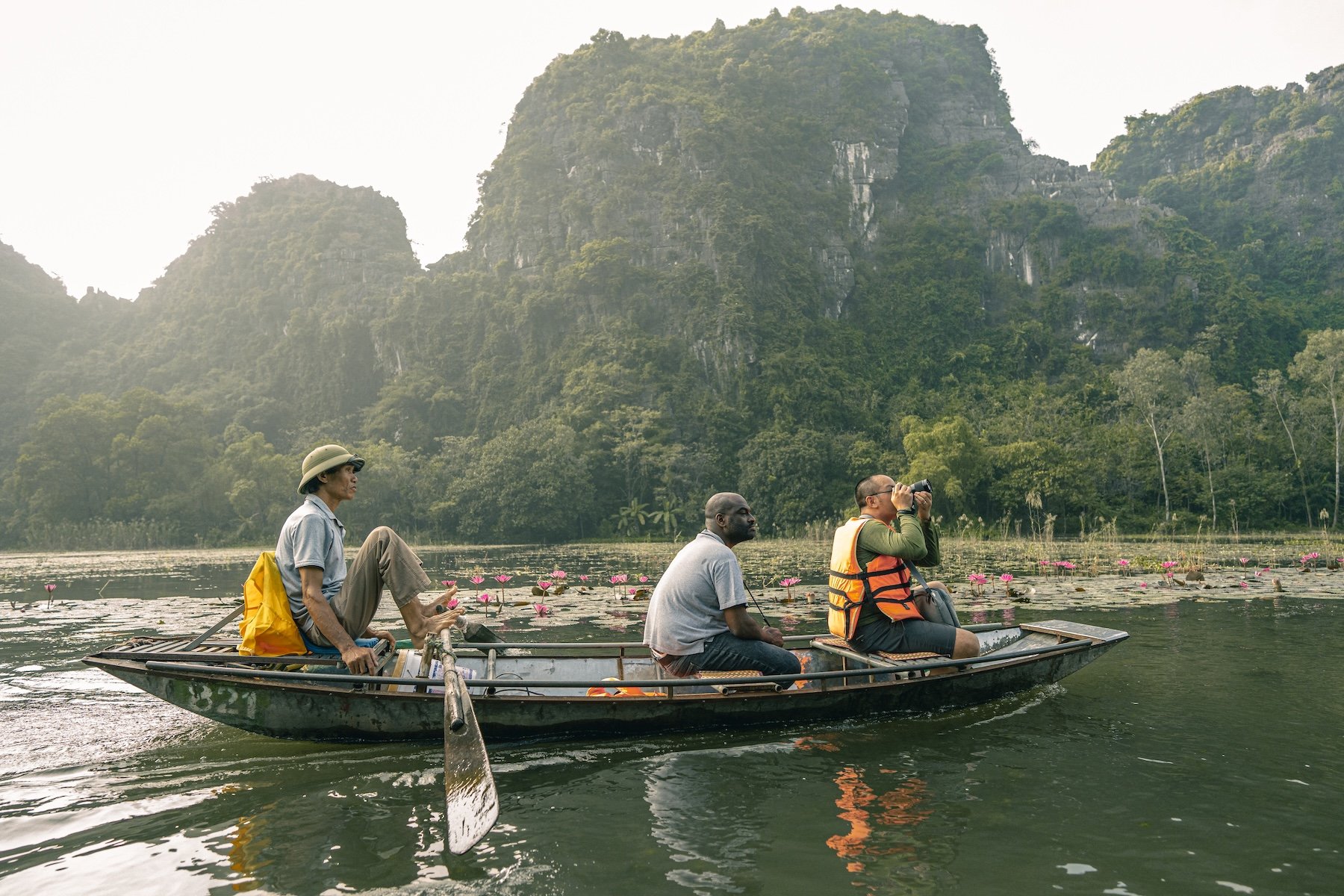
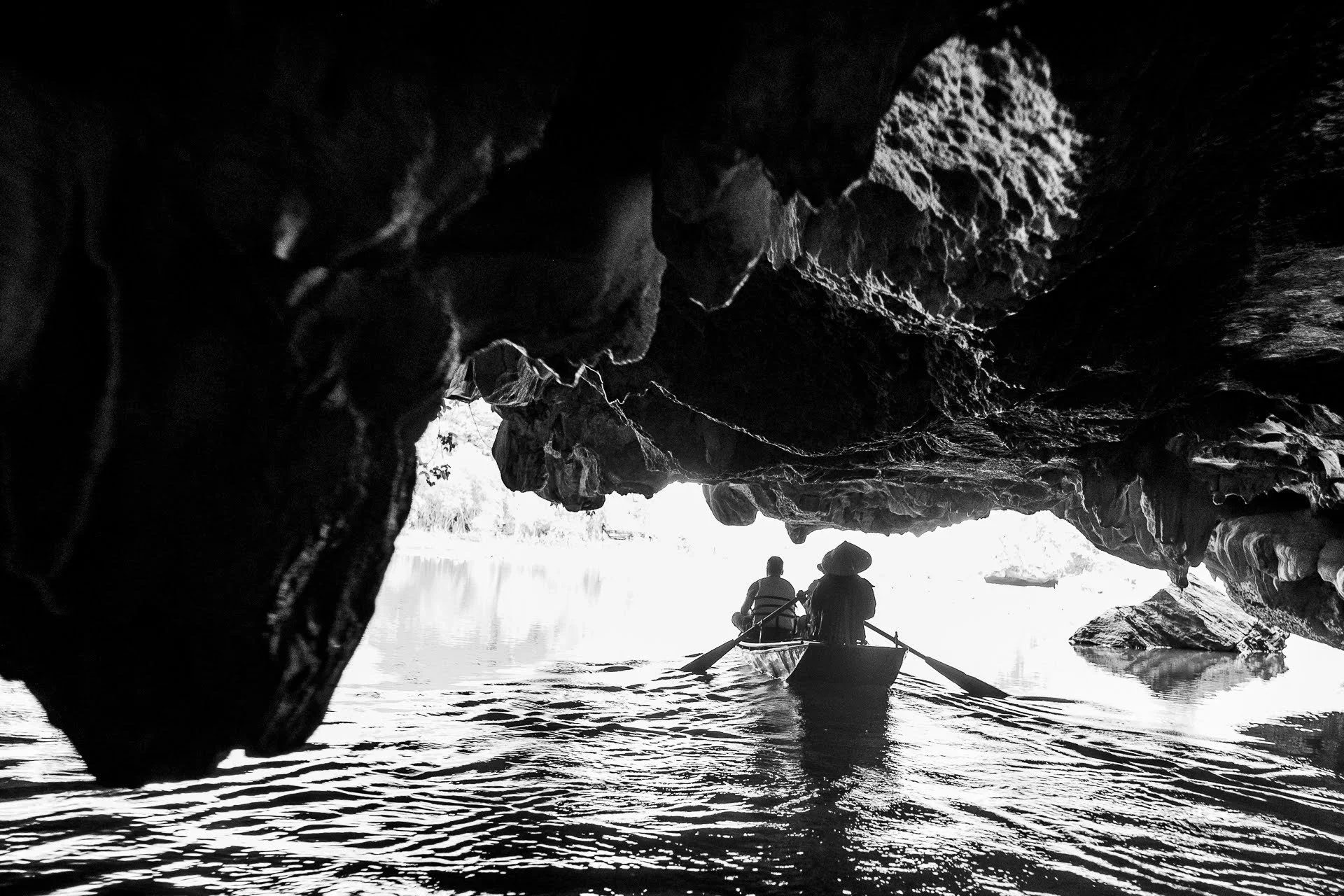
The river passage into the karst is one of the more unusual photographic experiences you are likely to have. Narrow, flat-bottomed wooden boats — each carrying two passengers and a single rower — thread through a corridor of flooded rice fields and into the belly of the limestone itself. Inside the cave, the shallow ceiling hangs low enough that you can reach up and touch it in some places.
The local guides — many of them women who have been making this crossing for decades — propel the oars not with their hands but with their feet. Sitting upright, they work the oar handles with the soles of their feet in long, fluid strokes, their hands resting in their laps or folded on the gunwale. It is a technique passed down through generations, perfectly adapted to a waterway where the same pair of hands need to wave off low-hanging rock in the dark.
© Bob Plotkin / X-Pedition Hanoi 2022
The light inside the caves is brief and dramatic — a few seconds of soft, reflected illumination before the dark closes around you again. The boats move slowly enough to compose, and the relationship between the guide, the oar, and the cave ceiling rewards anyone willing to put the camera in their lap and simply watch for the first pass before reaching for it on the second. In this, Tam Cốc teaches the same lesson Hanoi does: observe before you shoot. The photograph improves with each time you have seen the thing.
© Brian Mosley / X-Pedition Hanoi 2022
Hang Múa and the Climb
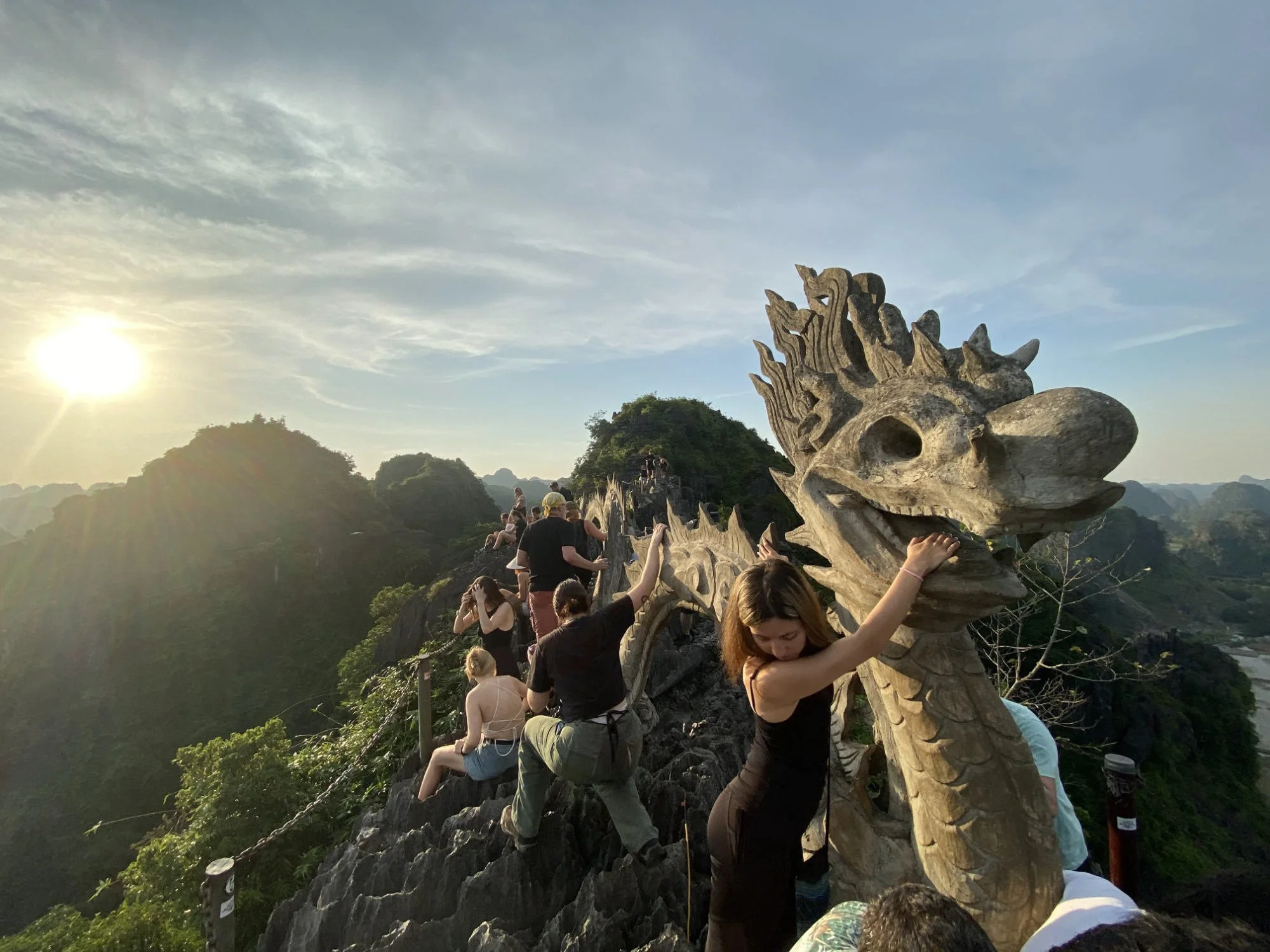
Above the village, the limestone peaks are not merely scenic backdrop — they are climbable. The trail up Hang Múa begins gently through agricultural land and low forest, then sharpens into a staircase of roughly 500 stone steps cut directly into the rock face. It is not technically demanding but if you’re not in reasonable shape, you’ll quickly feel the burn.
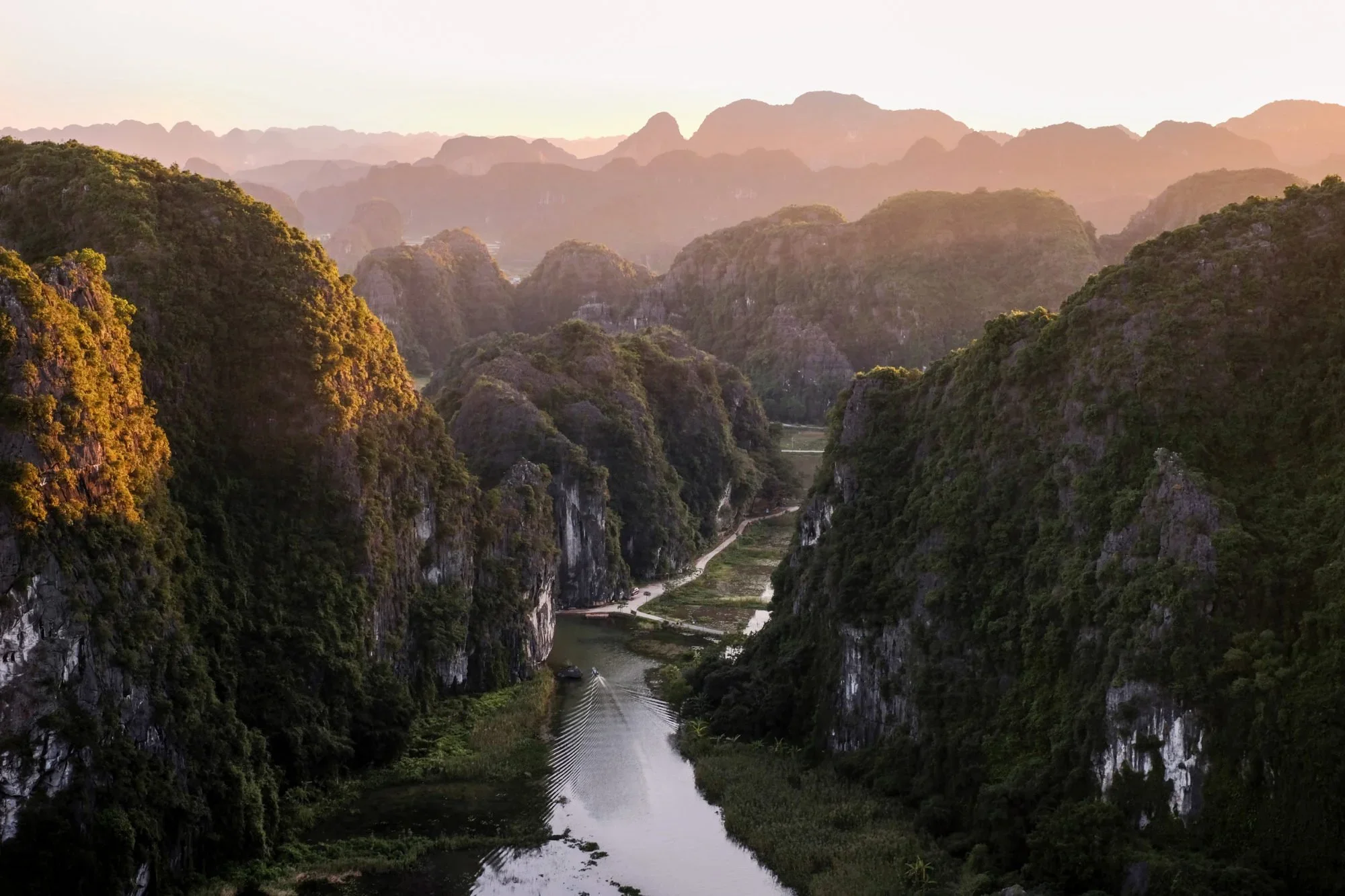
At the summit, the valley opens in every direction. The waterway and valley between the rock formations makes you reach for a longer lens. The karst formations repeat toward every horizon, each ridge a slightly different shade of green or grey depending on cloud cover and the hour. In late October, the light is warm and often hazy — the kind of diffuse, golden atmosphere that East Asian landscape painters have been chasing for a thousand years. You can see why.
© Jef Taylor / X-Pedition Hanoi 2022
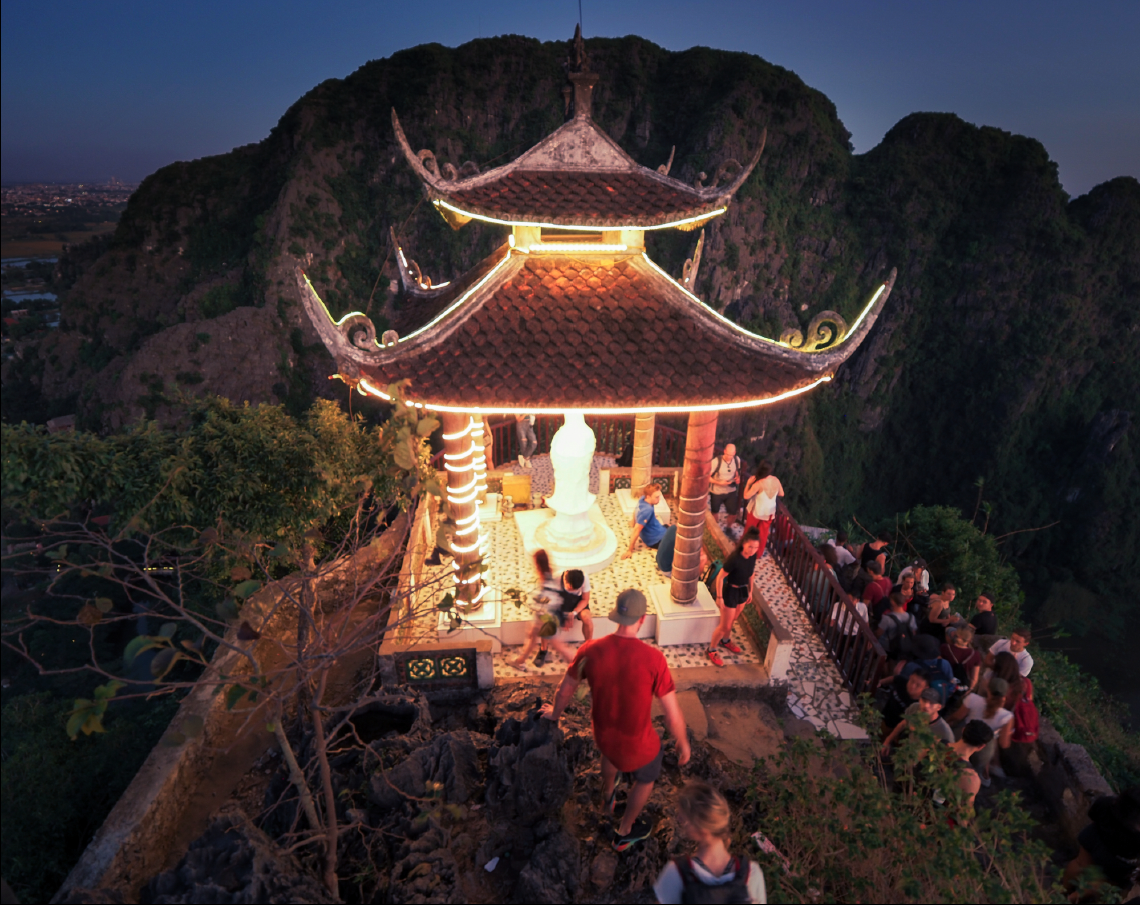
Photographically, the summit rewards patience. The light shifts quickly as cloud shadows move across the valley floor. The wide establishing shot presents itself immediately; what takes longer is the second photograph — a tighter frame, a considered foreground, a moment of movement from a bird or a distant boat that transforms the landscape into something less like a postcard and more like a place. Not the location, but what it felt like to be there.
© Michael Grigoriev / X-Peditions 2022
We will begin the climb at golden hour and, depending on how fast and far you decide to climb, you’ll descend either in the blue hour or nighttime.
The Temple, and What Surrounds It
Below the peak, the Bích Động pagoda complex works its way up into a separate limestone formation — a series of shrines and prayer halls built into natural cave recesses at different elevations. The approach is through a covered courtyard, past incense smoke and the particular stillness of a place where people have been arriving with intention for several centuries. It is not a tourist site dressed to look historic; it is the thing itself.
For photographers more comfortable with street work than landscape, the approach to the pagoda and the village pathways around it offer familiar territory: people moving through a defined space with purpose, faces lit by filtered natural light, a density of visual incident that rewards the same slow observation you use in the Old Quarter. The scale is smaller, the pace slower. Someone buying fruit from a cart near the temple entrance is doing exactly what someone buying bún bò from a sidewalk stall in Hanoi is doing — the camera's job is the same in both places.
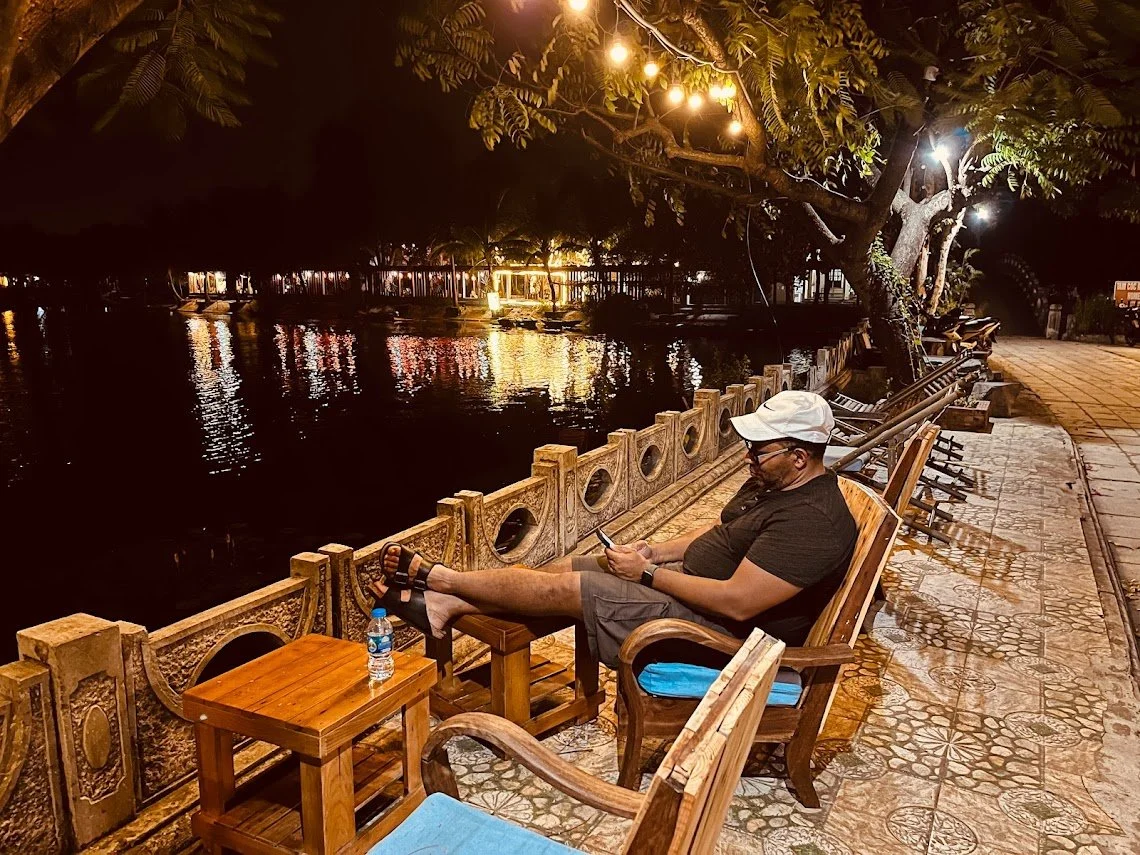
The surrounding region holds something else worth noting: quiet. Compared to Hanoi, Ninh Bình operates on a different rhythm. Village roads carry bicycles and the occasional scooter. Children play outside. The sounds are agricultural and ambient. For photographers who have found the city's energy productive but relentless, the day at Tam Coc offers a useful counterbalance — a chance to see how the same instincts apply when everything slows down.
© David Hobby / X-Peditions
Back to Hanoi by Sunset
The return drive lands the group back in Hanoi in the evening, which is not accidental. We timed it that way. You will have spent a full day in a different register — wider frames, slower light, a different kind of patience — and now the city is waiting with the particular energy of a Hanoi weekend night.
If the excursion to Tam Coc has recalibrated your eye — which it tends to — you will walk back into the Old Quarter seeing it slightly differently. That is the point. Not escape, but contrast. Not a break from photography, but a change in how you are doing it.
The photographs you make in the final days of the workshop are almost always the strongest. By then you have settled in. By then, the city has opened up. The trip in Tam Coc is part of how that happens.